
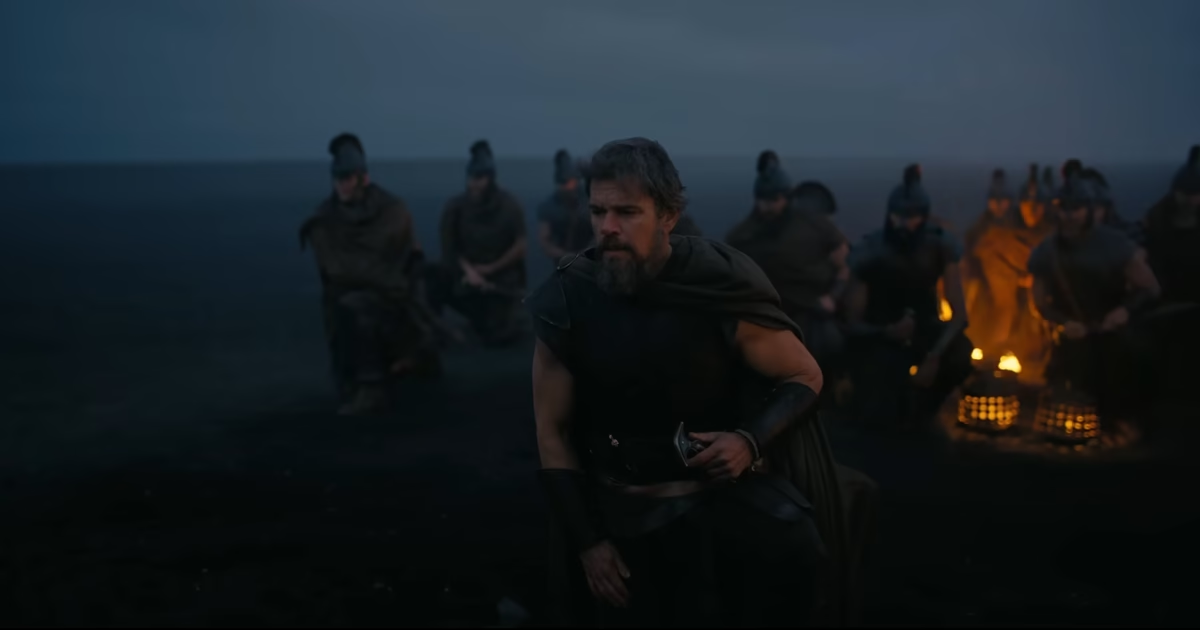
A Filmmaker Finally Meets His Match in Scale
Christopher Nolan has spent two decades building increasingly massive machines — dreams within dreams, a ticking-clock war epic, the birth of the atomic bomb. With The Odyssey, he goes back roughly 2,700 years and takes on Homer directly: Odysseus, king of Ithaca, fighting his way home across the Mediterranean after the Trojan War, chased by monsters, gods, and his own decisions. Shot across Italy, Greece, Morocco, Iceland, and Scotland using newly developed IMAX film technology, this is Nolan working at a scale even his own filmography hasn’t attempted before.
Matt Damon Anchors a Genuinely Stacked Cast
Matt Damon’s Odysseus carries the film’s emotional weight, and it’s a more weathered, internal performance than the marketing’s “mythic action epic” framing suggests. Around him, Nolan has assembled one of the year’s most loaded ensembles — Tom Holland, Anne Hathaway, Robert Pattinson, Lupita Nyong’o, Zendaya, and Charlize Theron all get moments to leave a mark, even in a film built around one man’s decade-long journey home. Ludwig Göransson’s score is used with more restraint than his previous collaborations with Nolan, working as momentum rather than the wall-to-wall bombast some of the director’s recent films have leaned on.
What Works: The Human Cost of a War Story
The film’s strongest instinct is treating the Odyssey less as an adventure and more as a story about what war does to the people who survive it — a quietly anti-war undercurrent running beneath all the sea monsters and cyclopses. Nolan structures the film the way Homer did, in flashback rather than strict chronology, and that choice pays off: it turns the film into a story about storytelling itself, about how the tales we tell each other can comfort, distort, and bind people together in equal measure. For a film this enormous in scope, it’s surprising how much of its power comes from character rather than spectacle.
What Doesn’t: The Spectacle Sometimes Feels Weightless
Not every critic has been won over by the scale. Some have pointed out that despite the film’s genuinely staggering geographic scope, the landscapes themselves don’t always carry the texture you’d expect — the sea, the cliffs, the sun all look impressive without quite feeling lived-in, especially when set against smaller, more intimate takes on the same material. It’s a fair criticism: bigger doesn’t automatically mean more immersive, and there are stretches where The Odyssey is clearly reaching for grandeur it doesn’t fully need.
The Verdict on Craft
Technically, this is about as accomplished as blockbuster filmmaking gets in 2026 — Hoyte van Hoytema’s cinematography and the sheer commitment to shooting on practical locations rather than leaning on digital backdrops give the film a physical weight that’s increasingly rare. Whether or not every emotional beat lands for you, it’s hard to argue anyone else working at this budget level is taking risks like this one.
Verdict
The Odyssey isn’t a flawless epic, but it’s an ambitious, sincerely felt one — Nolan’s most humanistic film in years, wrapped inside his biggest production yet. It asks a lot of its runtime and its audience, and mostly justifies both. Worth seeing on the biggest screen you can find.
Bullseye Rating: ★★★★ (4/5 stars)